
Sorting mixed merchandise pallets is the process of categorizing bulk liquidation inventory into sellable grades so you can price and list items across the right sales channels. The industry standard uses a four-grade classification: A-Grade, B-Grade, C-Grade, and Trash. Customer return pallets contain 50–70% sellable items, which means your profit depends entirely on how fast and accurately you sort. A general merchandise pallet, also called a mixed merchandise pallet, combines products from multiple retail categories in a single lot. Resellers who master the triage process consistently outperform those who inspect every item in detail.
How to sort mixed merchandise pallets: what the process actually involves
A mixed merchandise pallet is defined as a lot containing unsorted, multicategory retail returns or overstock from one or more retailers. The term “general merchandise pallet” refers to the same concept in wholesale and liquidation circles. Both terms describe inventory that arrives without a manifest, meaning you do not know exactly what is inside until you open it.
Processing a standard pallet of 100–200 items takes 15–25 hours, including sorting and listing, with most items selling within 30–90 days. That time estimate tells you something critical: sorting is labor, and labor is cost. Every minute you spend over-inspecting a $4 item eats directly into your margin.

The four-grade system is the foundation of every professional sorting operation. Return pallets grade out as A-Grade (40–50%), B-Grade (25–35%), and C-Grade (15–25%), with the remainder classified as Trash. Knowing these ratios before you open a pallet sets realistic expectations and helps you plan your workspace and time.
What you need before you start sorting
Preparation determines your sorting speed. Resellers who set up their workspace correctly before touching the pallet process inventory two to three times faster than those who improvise.
Essential supplies to have ready:
- Sorting bins or labeled boxes (minimum four: A, B, C, Trash)
- A heat gun and Goo-Gone for removing stickers and adhesive residue
- Cleaning materials: microfiber cloths, isopropyl alcohol, and surface spray
- Protective gloves to handle unknown items safely
- A label maker or pre-printed condition stickers
- A smartphone or tablet for quick price lookups
- A basic spreadsheet or inventory app for tracking high-value finds
Lighting matters more than most resellers expect. Dim or uneven light causes you to miss cosmetic damage on A-grade items and overlook hidden value on items you might otherwise toss. Set up your sorting area with overhead LED lighting and a clear, flat surface at waist height.
Pro Tip: Adopt a triage mindset before you touch the first item. Your goal is speed and categorization, not a detailed inspection of every SKU. Triage thinking accelerates pallet processing and directly improves your profit per hour.
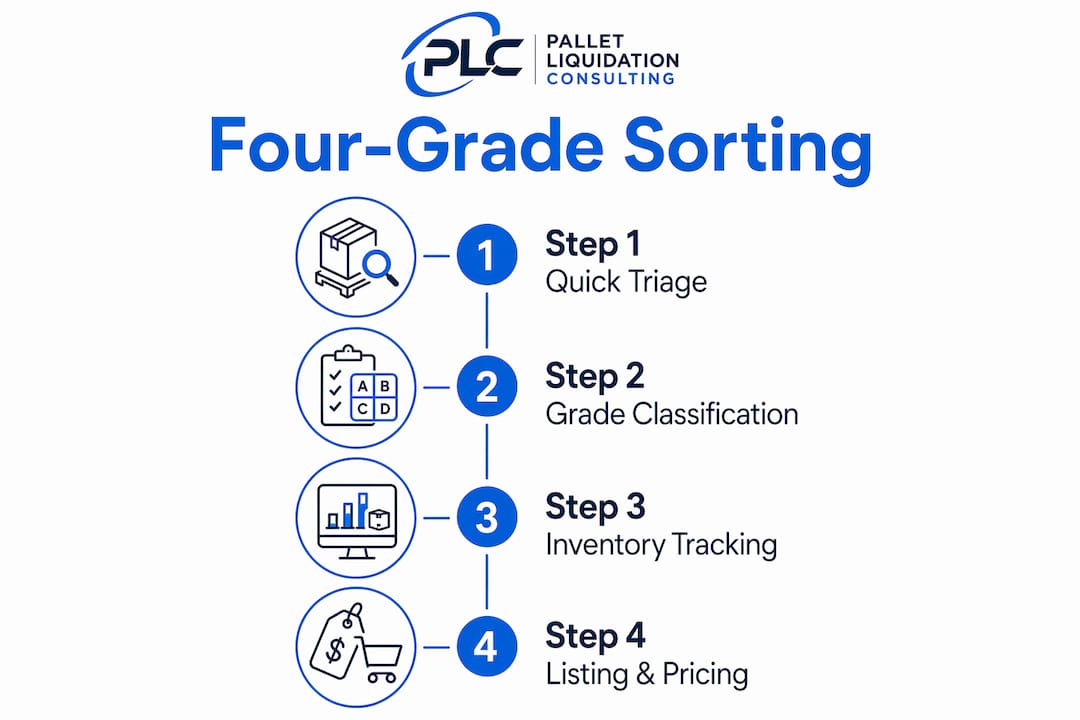
Inventory tracking does not need to be complex at this stage. A simple spreadsheet with columns for item description, grade, estimated value, and sales channel is enough to start. You can refine the system as your volume grows. The goal is to capture high-value items immediately so nothing gets lost in the pile.
Step-by-step process using the four-grade system
The most effective way to sort mixed merchandise pallets combines the four-grade classification with a three-pile triage system. Speed is the priority. Accuracy comes from practice, not from slowing down.
The four-grade classification
- A-Grade: Items in perfect or like-new condition, original packaging intact, fully functional. These command full retail or near-retail pricing.
- B-Grade: Items with minor cosmetic defects, missing accessories, or opened packaging. Fully functional but not shelf-ready.
- C-Grade: Items that are functional but visibly damaged, heavily worn, or missing key components. Suitable for parts buyers or deep-discount buyers.
- Trash: Broken beyond repair, unsanitary, or unsellable by any channel. Dispose of immediately.
The three-pile sorting approach
- Premier pile (items valued above $20): Electronics, brand-name tools, sealed goods, and anything with clear resale demand. These get individual attention and detailed listings.
- Bin pile (items valued at $1–$5): Small household goods, accessories, and low-margin items. These get grouped and sold in lots or at flea markets.
- Bulk or wholesale pile (heavy, bulky, or incomplete items): Furniture parts, large appliances, and items missing critical components. These move as wholesale lots or local pickup deals.
High-value electronics and anchor items should be identified first during your initial visual sweep. Anchor items are recognizable brand products that immediately recover a portion of your pallet cost. Finding a working HP laptop or a set of Hisense smart TVs in the first pass changes your entire financial picture for that pallet.
Sorting order for maximum throughput
- Do a full visual sweep of the pallet before touching anything. Identify anchor items and pull them first.
- Remove and set aside all obvious Trash. Do not sort it. Do not inspect it. Remove it.
- Sort remaining items into Premier, Bin, or Bulk piles using a quick visual and tactile check.
- Grade Premier pile items individually: A, B, or C.
- Batch Bin pile items by category for group listings.
- Stage Bulk pile items for local sale or wholesale lot pricing.
Pro Tip: If an item looks like a $5 item, treat it as a $5 item. Do not spend four minutes researching its exact model number. Move on. Your profit comes from volume and speed, not from squeezing an extra dollar out of low-margin pieces.
How to list sorted items for maximum profit
Sorted inventory only generates profit when it reaches the right buyer on the right platform. Different sales channels perform best for different item grades. Matching grade to channel is as important as the sorting itself.
Platform matching by grade:
- A-Grade items: List on eBay and Amazon. These platforms attract buyers willing to pay near-retail for verified condition items. Use competitive pricing based on current sold listings, not asking prices.
- B-Grade items: Facebook Marketplace, Mercari, and Poshmark work well for this tier. Local buyers and niche shoppers accept minor defects when the price reflects the condition.
- C-Grade and bulk items: Sell locally via Facebook Marketplace pickup, offer wholesale lots to other resellers, or list as parts-only on eBay. Do not try to retail C-grade items on Amazon.
Photography directly affects your sell-through rate. Clean, well-lit photos on a neutral background convert faster than cluttered or dark images. Write descriptions that state the condition clearly, list any defects honestly, and include model numbers for searchability.
Pro Tip: Batch your listings by category on the same day. Listing ten similar items in one session is faster than listing one item per day across ten sessions. Your listing efficiency compounds over time and reduces per-item labor cost.
Shipping strategy matters for A-grade and B-grade items. Offer calculated shipping on eBay rather than free shipping for heavy items. For local channels, require pickup for anything over 20 pounds. Bundling small B-grade items into lots of five or ten reduces your listing count and moves inventory faster.
Common mistakes that kill your sorting efficiency
Most sorting errors fall into two categories: spending too much time on low-value items, and working in a disorganized space. Both problems are fixable.
Mistakes to avoid:
- Spending more than 60 seconds trying to identify an unknown item. The 60-second identification rule keeps your throughput high. If you cannot identify it quickly, treat it as a bin or bulk item and move on.
- Ignoring the “tail” of the pallet. The bottom 20% of most pallets contains mostly broken parts and trash. Experienced sellers clear the tail aggressively rather than hunting for small wins in damaged inventory.
- Poor workspace organization. A cluttered sorting area causes misplaced items, missed grades, and wasted time searching for tools.
- Emotional attachment to items. If the market says an item is worth $3, it is worth $3. Price to sell, not to recover what you paid.
- Skipping the initial visual sweep. Diving straight into item-by-item sorting without identifying anchor items first means you may bury high-value finds under low-value bulk.
“Successful resellers focus on high-volume processing and fast-fail decisions rather than perfect knowledge of every SKU. The goal is to move inventory, not to become an expert on every product that crosses your table.”
A well-trained team multiplies your throughput. If you work with others, assign roles: one person pulls and does the initial sweep, another grades and labels, and a third stages items for listing. This assembly-line approach cuts per-pallet processing time significantly. You can learn more about avoiding common pallet pitfalls before your next purchase.
Key takeaways
Efficient sorting of mixed merchandise pallets requires a triage mindset, the four-grade classification system, and platform-matched listing strategies to convert bulk inventory into consistent resale profit.
| Point | Details |
|---|---|
| Use the four-grade system | Classify every item as A, B, C, or Trash to price and list accurately across channels. |
| Apply the three-pile triage | Sort into Premier, Bin, and Bulk piles first to maintain speed before detailed grading. |
| Identify anchor items first | Pull high-value electronics and brand items immediately to recover pallet cost fast. |
| Match grade to sales channel | A-grade goes to eBay or Amazon; B-grade to Facebook or Mercari; C-grade sells locally or as lots. |
| Apply the 60-second rule | Drop any item you cannot identify within 60 seconds into the bin or bulk pile and move on. |
What I’ve learned from watching resellers get this wrong
The biggest mistake I see resellers make is treating sorting like a treasure hunt. They slow down every time they find something interesting, pull out their phone, research the item for ten minutes, and lose the rhythm of the entire session. By the time they finish one pallet, they have spent 30 hours on work that should have taken 18.
The triage mindset is not a shortcut. It is the correct professional standard. Pallet sorting is a critical asset management function, and treating it as anything less costs you money. The resellers who scale past one or two pallets per week are the ones who have internalized speed as a value, not just accuracy.
What I find most underrated is the importance of clearing the tail fast. Most resellers linger on the bottom of the pallet hoping to find something worth saving. The math rarely works. The time you spend on the tail almost always exceeds the value you recover. Clear it, dispose of it, and move to the next pallet.
The other insight worth emphasizing: efficient sorting connects directly to your broader business health. Resellers who sort well also tend to list faster, price more accurately, and manage cash flow better. The discipline you build at the sorting table shows up everywhere else in your operation. Start with one pallet, time yourself, and improve your process with each one you open.
— elianne
Where to source pallets worth sorting
Palletliquidationwholesaleonlineinusa sources mixed merchandise pallets directly from top U.S. retailers, giving resellers access to verified inventory across electronics, apparel, tools, and more. With nearly a decade of experience, the platform offers truckload pricing that makes bulk buying practical for resellers at every scale. Flexible payment options and direct shipping make it straightforward to get started without a large upfront commitment. If you are ready to put your sorting skills to work, browse available pallets and find the right lot for your operation. You can also review the full buying guide for liquidation pallets to make sure your first purchase sets you up for a profitable sort.
FAQ
What does a mixed merchandise pallet contain?
A mixed merchandise pallet contains unsorted retail returns or overstock from multiple product categories, typically including electronics, apparel, household goods, and tools. The contents vary by lot and retailer source.
How long does it take to sort a mixed pallet?
Processing a pallet of 100–200 items takes 15–25 hours including sorting and listing. Most items sell within 30–90 days of being listed.
What percentage of pallet items are sellable?
Customer return pallets typically contain 50–70% sellable items. Higher-grade lots command premium pricing, while shelf pulls offer better condition but less consistent high-value finds.
What is the best platform to sell sorted pallet items?
A-grade items sell best on eBay and Amazon, B-grade items perform well on Facebook Marketplace and Mercari, and C-grade or bulk items move fastest through local pickup or wholesale lot listings.
What is the 60-second rule in pallet sorting?
The 60-second rule means that any item you cannot identify within 60 seconds gets assigned to the bin or bulk pile immediately. This keeps your sorting pace high and prevents time loss on low-margin unknowns.
Recommended
- How to Evaluate Return Pallets for Profit – Pallet in USA
- Buying Liquidation Merchandise Pallets – Pallets in USA
- Pallet Liquidation Wholesale Online – Pallet Liquidation USA
- Box Lots Versus Pallet Lots – Pallet Liquidation USA
